








INSPIRED BY STARS

Best Astrologer In Guwahati

Astologer Sailyajit

Best Astrologer in Guwahati

Astro Sailyajit ® - Reliable Name In The Industry

best astrologer in guwahati
Introducing The best astrologer in guwahati

About Astro Sailyajit ®

TRADITIONAL KNOWLEDGE WITH SCIENTIFIC APPROACH


Acharya Sailyajit is a Hereditary Assamese Vedic Astrologer and the best astrologer in Guwahati. He hails from an orthodox family in Guwahati, Assam (The Land of Adi Shakti Maa Kamakhya), India. He has inherited the science of Astrology from his granduncle and forefathers. He began his journey in the field of astrology and numerology from age of 15.

Today he is one of the most renowned astrologers in Guwahati with over 18+ years of experience in Astrology, Vastu, Gemology, Numerology, Tarot card Reading, Kaal Sarp Yog Specialist as well as an expert in Kamakhya Puja. He gives accurate remedies and lifelong protection to his clients.

vedic astrology with sailyajit
Best Astrologer trainer in guwahati

Best Astrologer in Guwahati

Revolutionizing Astrology for the Modern Mind

18+ Years of

Mastery in Assamese Tantric Astrology

65K+

Comprehensive Horoscope Consultations (Online & Offline)

2K+

Vastu Consultations Transforming Homes & Workspaces

6.5K+

Precision Numerology Consultations for Success

100K+

Personalized Hand Written Horoscope Notes—Your Life Blueprint

Palmistry Analysis

13+ Countries

Global Footprint: Trusted by Clients

400K+

Lives Impacted—Bringing Clarity, Confidence & Change

guided 4.4K +

scientists, bureaucrats, politicians, business tycoons, startups, astrologers, PhDs, life coaches, and celebrities across the globe.

New Paths to Wisdom & Prosperity

Past life karma

Discover your karmic journey, uncover life’s hidden patterns, and receive remedies to balance destiny for a fulfilling future.

Vyapaartantra

Boost business success with Vastu solutions that attract prosperity, harmony, and growth in every venture.

Astro Sailyajit ® Services

Experience The Astro Services

astrology service

Astrology Service

Sailyajit is a Hereditary Vedic Astrologer and hails from an orthodox family.

vastu service by astro sailyajit

Vastu Service

Transform your space and invite positive energy with the best Vastu service in Guwahati by Astrologer Sailyajit.

Palmistry Analysis

Tattoo Astrology

Discover Tattoo Astrology with Acharya Sailyajit. Get astro-guided tattoos aligned with your planets and birth chart to attract success, love, and harmony.

best numerology advice in Guwahati

Numerology Advice

Unlock the power of numbers and receive the best Numerology advice in Guwahati by Astrologer Sailyajit.

Tarot card reading service in Guwahati

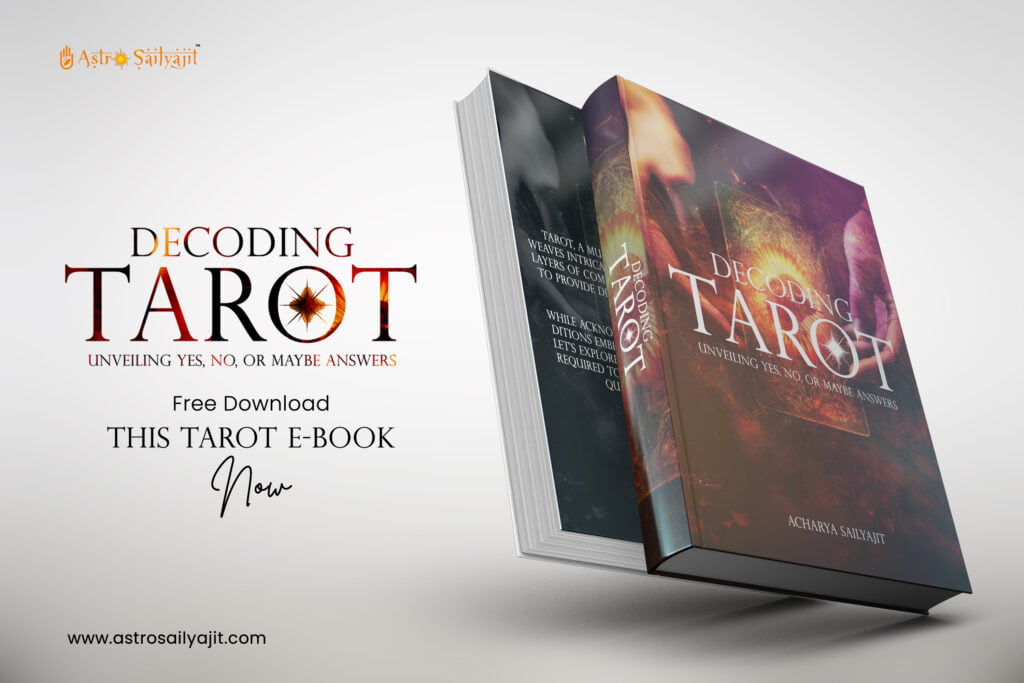
Tarot Card Reading

Discover the hidden insights of your life through the best Tarot Card Reading in Guwahati by Astrologer Sailyajit.

Vedic Puja Hawan in Guwahati

Vedic Puja Havan

Elevate your spiritual journey with Vedic Puja Havan in Guwahati led by Astrologer Sailyajit.

Astro Sailyajit - best astrologer in Guwahati
WHY CHOOSE ASTRO SAILYAJIT ®?

Why Choose Astro Sailyajit ® as your Astrologer?

If you're looking for the best astrologer in Guwahati, you'll want to consider Sailyajit Baruah. With his extensive experience and knowledge of Vedic astrology, he can provide accurate predictions and expert guidance for all your life's problems.

One of the reasons to choose Sailyajit as your astrologer is his in-depth knowledge of Vedic astrology. He has studied this ancient practice for many years, and his expertise is evident in the accurate predictions he provides. He uses various tools and techniques to analyze your birth chart, including the position of the planets and the movements of the stars.

Another reason to choose Sailyajit is his friendly and approachable demeanor. He understands that seeking astrological guidance can be intimidating, and he goes out of his way to put his clients at ease. He listens carefully to their concerns and provides thoughtful and personalized advice.

In addition, Sailyajit offers a wide range of astrological services. Whether you need guidance on your career, relationships, or health, he has the expertise to help. He also offers remedies to help mitigate any negative effects of planetary influences.

If you're looking for the best astrologer in Guwahati, Sailyajit Baruah is a great choice. His knowledge, approachable nature, and wide range of services make him an excellent resource for anyone seeking astrological guidance.

Our Course

Step into the world of Vastu Shastra and transform your knowledge into a rewarding career with Acharya Sailyajit’s 6-month Online Weekend Certificate Course in Guwahati. Learn authentic, practical Vastu techniques and become a certified professional.

What You Will Learn

Vastu for Home & Flat

  • Core principles to harmonize living spaces

  • Optimize health, wealth, and relationships through Vastu

Numero Vastu & Aqua Sensing

  • Integrate numerology with Vastu for precise results

  • Exclusive Sailyajit Vastu Aqua Sensing Techniques

Personal Dowsing & Practical Workshop

  • Detect and correct energy imbalances in any space

  • 2-day hands-on workshop for real-world application

Professional Benefits

  • Learn from Astrologer Acharya Sailyajit, Northeast India’s trusted Vastu mentor

  • Practical skills to start your own consultancy and earn lakhs

  • Certification from a Global Accredited Gurukul (JAF | ΙΛΟ | ISO)

Course Duration: 6 Months (Weekend Online Classes)
Course Fee: ₹63,000 INR Last Date for Enrolment: 30th December 2025

Enroll Now—Limited Seats | Real Vastu | Real Knowledge | Real Result

Astro Sailyajit® Basic Predictive Astrology Course

Learn from the Predictive Occult Mentor® Acharya Sailyajit

What You Will Learn

Foundation of Vedic Astrology (Planets, Signs, Houses, Nakshatras)
Birth Chart Reading & Horoscope Interpretation
Predictive Techniques for Health, Career, Marriage & Wealth
Understanding Dasha Systems (Mahadasha–Antardasha)
Remedies through Mantra, Gemstones & Karmic Balancing

Choose Sanatan Knowledge and Earn in Lakhs

Course Fee: ₹63,000/-
Duration: 6 Months ONLINE
Last Date of Enrollment: 31st December 2025
Classes Begin: January 2026

Master the ancient science of prediction and transform your life with the guidance of Acharya Sailyajit—The Intelligent Man’s Astrologer.

Global Accredited Gurukul

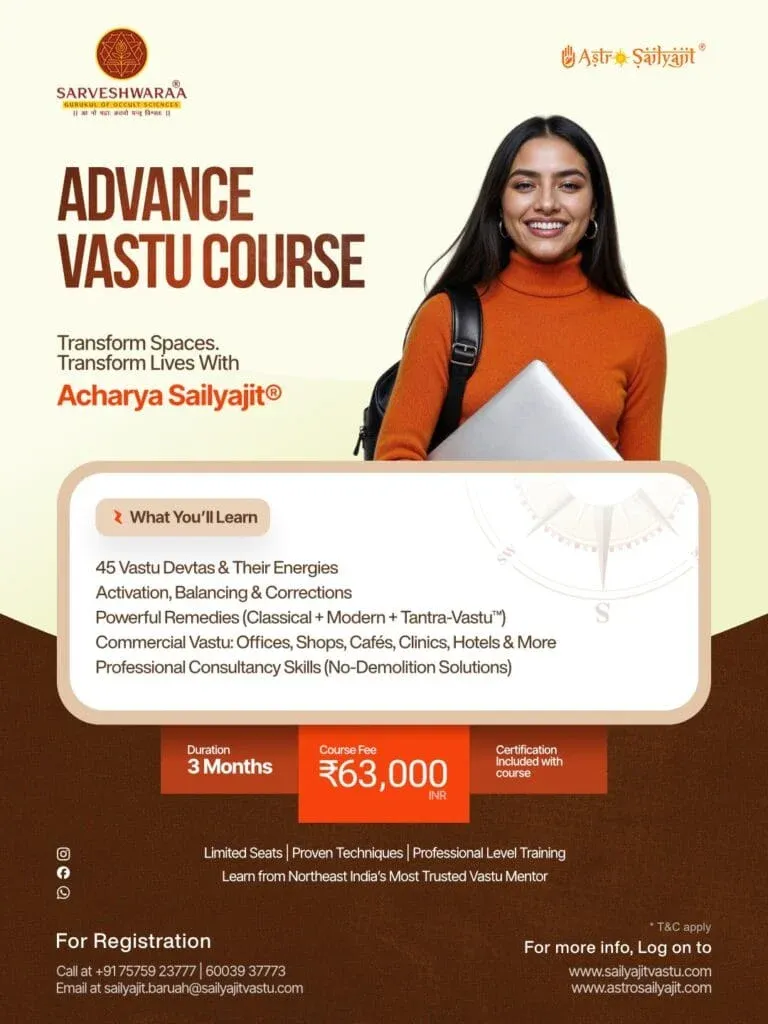
Unlock the deepest secrets of Vastu with Acharya Sailyajit’s advanced 3-month professional training:

45 Vastu Devtas & Their Energies
– Understanding each Devta in the Vastu Purusha Mandala
– How Devta energies impact health, wealth, career & relationships
– Activation, correction & balancing of Devta zones

Devta-Based Remedies
– Powerful classical & modern Vastu remedies
– Colour therapy, object placement, directional corrections
– Tantra-Vastu™ corrections (exclusive teachings)

Commercial Vastu Mastery
Perfect for professionals, shop owners & entrepreneurs
Learn Vastu for:
– Offices
– Shops & showrooms
– Restaurants & cafés
– Clinics, salons, boutiques
– Hotels, resorts & commercial complexes

Professional Skill Development
– Reading layouts & blueprints
– Diagnosis of Vastu Doshas
– Remedies without demolition
– Becoming a certified consultant

Course Duration: 3 Months
💰 Course Fee: ₹63,000/-
Limited Seats | Real Vastu | Real Knowledge | Real Results
Learn from Northeast India’s Most Trusted Vastu Mentor—Acharya Sailyajit®.

Unlock the secrets hidden in your hand and your home with the first-of-its-kind course on Chiromancy Vastu, founded by Acharya Sailyajit, North East India’s most trusted Astro-Vastu Expert.
🔍 What You Will Learn:
✅ How to read palms for elemental balance
✅ Mapping palm elements to Vastu zones
✅ Diagnosing karmic imbalances in your space
✅ Remedies based on palm-Vastu alignment
✅ Powerful correction methods using direction, color, yantra & energy flow
📜 Bonus Topics:
🎁 Planetary Palm Remedies
🎁 Palm-Based Business & Career Guidance
🎁 Palm-Vastu for Love, Health & Wealth
🧙‍♂ Course Highlights:
🕉 Developed by Acharya Sailyajit, Occult Mentor®
📅 Duration: 3 Days / One Month (Online & Offline options)
📍 Location: Guwahati | Available Worldwide via Zoom
📜 Certificate of Completion + Practitioner Level
📚 Course Materials Included
🎓 Ideal For:
🔹 Astrologers
🔹 Vastu Consultants
🔹 Palmists
🔹 Healers, Therapists & Coaches
🔹 Anyone Curious to Learn Spiritual Science with Practical Impact
🔔 Limited Seats | Pre-book Now!

tatto astrology course in guwahati

Tattoo Astrology
Design Your Destiny in Ink

Booking Your Tattoo Astrology Session

Your body is more than a canvas—it reflects your cosmic journey. Every tattoo carries energy, intention, and vibration that aligns with the stars. Through Tattoo Astrology, Acharya Sailyajit, India’s trusted Astro-Vastu & Occult Mentor™, designs tattoos that are both artistic and spiritually aligned with your birth chart and planetary energies. Each symbol, placement, and timing is carefully chosen to harmonize your aura and unlock your potential, whether for love, success, protection, or spiritual growth. With over 18 years of expertise, Acharya Sailyajit transforms tattoos into living talismans of destiny.

Certification & Duration

  • 4weeks| Online & offline
  • Fee-17,700
  • Trainer-acharya Sailyajit
  • Enrollment ends on 31st Dec 2025

Reviews on Astro Sailyajit ®

Our Highly Satisfied Clients

Know More

Illustration depicting two intertwined karmic paths of marriage in Vedic astrology
Astrology

Impact of Vastu on Married Life: Harmony, Separation & Extra-Marital Affairs

Marriage, in Vedic philosophy, is more than an emotional bond — it is the merging of two karmic energies within a shared space. According to Vastu Shastra, the home becomes a living field that shapes love, trust, and emotional balance between partners. When the five elements — Earth, Water, Fire, Air, and Space — fall out of harmony, they disturb intimacy, communication, and stability.

Two-Marriage Yoga – Dwivivaha Secrets in Vedic Astrology
Astrology

Two-Marriage Yoga-When Karma Writes Two Love Stories

In astrology, marriage is not just a bond but a journey of the soul through karmic lessons. Sometimes destiny grants two unions — one to awaken, another to heal. Known as Dwivivaha Yoga or Two-Marriage Yoga, this phenomenon reveals how planetary alignments in the seventh house, Venus, and Rahu–Ketu axis shape two chapters of love in one lifetime.

accreditation

We Are Certified by

Our Publications

Available on Google play, Kindle, Flipkart and Amazon

New Updates

Comments Box SVG iconsUsed for the like, share, comment, and reaction icons
2 days ago

জুবিন আৰু জ্যোতিষশাস্ত্ৰ: ২০০৮ চনৰ অনুপ বৰুৱাৰ দ্বাৰা তোলা এখন ফটো, য’ত তেওঁক হাতত এটা নীলম আৰু বাহুত ৰঙা প্ৰবাল,নীলম আৰু পোখৰাজ পিন্ধি থকা দেখা গৈছে।

​জীৱনত উন্নতি কৰিবলৈ জ্যোতিষশাস্ত্ৰত বিশ্বাস ৰাখক, কিন্তু উন্নতি কৰাৰ পিছত জ্যোতিষশাস্ত্ৰক পাহৰি নাযাব।
... See MoreSee Less

জুবিন আৰু জ্যোতিষশাস্ত্ৰ: ২০০৮ চনৰ অনুপ বৰুৱাৰ দ্বাৰা তোলা এখন ফটো, য’ত তেওঁক হাতত এটা নীলম আৰু বাহুত ৰঙা প্ৰবাল,নীলম আৰু পোখৰাজ  পিন্ধি থকা দেখা গৈছে।

​জীৱনত উন্নতি কৰিবলৈ জ্যোতিষশাস্ত্ৰত বিশ্বাস ৰাখক, কিন্তু উন্নতি কৰাৰ পিছত জ্যোতিষশাস্ত্ৰক পাহৰি নাযাব।
4 days ago

Sailyajit Vastu for Land
Strategic Energy Mapping for a Prominent Businessman’s Upcoming Bungalow
Luxury Quote Options (Short & Authoritative):
“Before you build walls, align destiny.”
“Land decides legacy. Design only executes it.”
“A wrong plot delays success. A right plot compounds it.”
“We don’t just check land. We de-risk your future.”
“Real estate is an asset. Aligned land is a multiplier.”
Choose land with intelligence. Build with precision.
Vastu-compliant site planning by Sailyajit Vastu.
Your bungalow deserves more than architecture.
It deserves aligned energy, verified on-site.
... See MoreSee Less

4 days ago

Sage Nārada as an Astrologer and Seer of Destiny

By Acharya Sailyajit

Ancient India conceived of astrology (jyotiṣa) not as horoscope trivia but as a science of time and karma — a disciplined way of understanding when events are most likely to unfold based on deeper causal forces. Within this tradition the figure of Sage Nārada stands out in Sanskrit literature as a being endowed with far-reaching insight into destiny, frequently acting as a revealer of futures that are aligned with cosmic justice rather than personal preference. Multiple scriptural sources portray him not merely as a narrative commentator but as a seer whose statements catalyze or confirm the ripening of destiny.

Nārada’s Role in the Kamsa–Krishna Narrative
One of the clearest and most-cited episodes attributed to Sage Nārada occurs in the Harivaṁśa, an appendix to the Mahābhārata. In the Vishnu Parva of this text, Nārada goes to Mathurā and tells King Kamsa that he will die at the hands of Devaki’s eighth child. This is one of the most direct prognostications attributed to Nārada in Sanskrit literature.
The text states that Nārada informs Kamsa that he saw divine counsels on Mount Sumeru and was told that his death would be caused by that very child (the future Krishna) — destroying Kamsa’s complacency and setting in motion the tension that defines the next phase of Krishna’s birth story.
Although the earliest critical editions of the Śrīmad Bhāgavatam record the prophecy about Devaki’s eighth son through an unembodied heavenly voice (ākāśavāṇī), traditional commentaries link the later Harivaṁśa episode with Nārada’s intervention. After the divine prophecy, Nārada’s visit intensifies Kamsa’s fear and eventually leads to cruelty that accelerates the destined confrontation.
In some traditional narrations not found directly in the Sanskrit text but preserved in later commentarial or sectarian traditions, Nārada is quoted as saying to Kamsa:
“You are to be killed by the eighth son of Vasudeva — that eighth son is Krishna.”
Whether read literally or as later interpretive development, these accounts reflect the widespread cultural conviction that Nārada helped clarify the timing and identity of the destined destroyer of Kamsa.

Nārada and the Sin Amplification Strategy
An important aspect attributed to Nārada in traditional commentaries (especially in Śrīla Jīva Gosvāmī’s notes on the Bhāgavatam) is his strategic purpose in making Kamsa doubt his safety. According to those commentaries, Nārada advised Kamsa that because Vishnu was to kill him, he should not spare any children born to Devaki — thereby provoking Kamsa to kill them and increase the sin that would hasten Krishna’s appearance to kill him.
This formulation — that Nārada’s intention was to accelerate cosmic justice — is not present in the earliest Sanskrit prose of the Bhāgavatam but is found in later traditional exegesis and in devotional interpretive compilations. It illustrates how later commentators saw Nārada’s role as not only predictive but kinetically involved in timing destiny.

Nārada and the Protection of Kayadhu
In the Bhāgavata Purāṇa it is recorded that when Indra’s forces attempted to seize Kayadhu, the wife of Hiranyakashipu, Narada stepped in and asserted that she was sinless and must be released. This intervention allowed Kayadhu’s unborn child — Prahlāda — to grow under Nārada’s spiritual influence.
Here, though not a horoscope or formal divination scene, Nārada’s role has destiny implications: he ensures Prahlāda’s protection and spiritual formation. The boy later becomes a central figure in the destiny of the asuras and the appearance of the Nṛsiṁha avatāra — a nuanced example of prophetic guidance influencing karmic outcomes.

Indirect but Scriptural Associations
There are later episodes referenced in the Mahābhārata’s Mausala Parva where Nārada is present among sages who curse the Yadava youths dressed in mock pregnancy to predict gender, supposedly triggering the eventual self-destruction of the Yadava clan. Although this story belongs to a cycle removed from the core Bhāgavata narrative and is subject to variant recensions, it is widely cited in secondary accounts of the Yadava clan’s destiny after Krishna’s departure.
In this episode, the prediction itself (gender of the unborn child) is less significant than the resulting curse and the eventual fulfillment of fate, illustrating that Nārada’s presence is often linked with cosmic corrections guided by destiny logic.

Does Nārada read horoscopes?
It is important to define what “astrologer” means in this context. In the modern sense it implies mathematical charts, planetary positions, and daśā periods. Ancient Sanskrit narratives do not generally include technical horoscope calculations in kathas (stories). However, they do depict moments where Nārada interprets marks, omens, and destiny signs, and in at least one clear episode in the Śiva Purāṇa, Nārada is asked to read Parvatī’s destiny.
Textual accounts of that episode record that Queen Mena and King Himavat request Nārada to tell them who Parvatī will marry because her nature, character, and future are of concern. Nārada replies with auspicious predictions about her life as Śiva’s consort and her spiritual strength — effectively reading her destined characteristics and life path. This represents a form of classical astrological interpretation present in Sanskrit literature, though not in the technical mathematical format seen in later classical jyotiṣa texts.

Patterns in Nārada’s Prophetic Activity
Across these accounts a clear pattern emerges:
• Prediction of impending death (Kamsa) tied to cosmic justice.
• Catalytic messaging that accelerates fate rather than defers it.
• Protection and spiritual grooming of individuals destined for greatness (like Prahlāda).
• Destiny reading based on inherent nature (Parvatī’s future).
• Presence in major destiny-fulfilling cycles (Yadava self-destruction) as a seer whose presence intimates time’s unfolding.
The interpretations may vary among traditions, but the consistent role of Nārada across these texts is not as a casual storyteller but as a revealer and confirmer of destiny at the right temporal juncture — a classical trait recognized in jyotiṣa as insight aligned with karmic windows and cosmic rhythm.

Nārada as Destiny Interpreter, Not Casual Astrologer
Sage Nārada’s role in ancient Indian literature is best understood through the lens of destiny affirmation and timing insight rather than purely technical horoscope computation. Where the Sanskrit texts do present him as reading future outcomes or advising on the course of events, his statements align with karmic logic, cosmic justice, and the purposeful ripening of fate. Some of his most memorable interventions — such as informing Kamsa of his destined death and interpreting Parvatī’s future — serve to confirm that in the Indic worldview prophecy functions as a disciplined expression of time-science and dharma, not mere guesswork.
... See MoreSee Less

Sage Nārada as an Astrologer and Seer of Destiny

By Acharya Sailyajit

Ancient India conceived of astrology (jyotiṣa) not as horoscope trivia but as a science of time and karma — a disciplined way of understanding when events are most likely to unfold based on deeper causal forces. Within this tradition the figure of Sage Nārada stands out in Sanskrit literature as a being endowed with far-reaching insight into destiny, frequently acting as a revealer of futures that are aligned with cosmic justice rather than personal preference. Multiple scriptural sources portray him not merely as a narrative commentator but as a seer whose statements catalyze or confirm the ripening of destiny.

Nārada’s Role in the Kamsa–Krishna Narrative
One of the clearest and most-cited episodes attributed to Sage Nārada occurs in the Harivaṁśa, an appendix to the Mahābhārata. In the Vishnu Parva of this text, Nārada goes to Mathurā and tells King Kamsa that he will die at the hands of Devaki’s eighth child. This is one of the most direct prognostications attributed to Nārada in Sanskrit literature.
The text states that Nārada informs Kamsa that he saw divine counsels on Mount Sumeru and was told that his death would be caused by that very child (the future Krishna) — destroying Kamsa’s complacency and setting in motion the tension that defines the next phase of Krishna’s birth story. 
Although the earliest critical editions of the Śrīmad Bhāgavatam record the prophecy about Devaki’s eighth son through an unembodied heavenly voice (ākāśavāṇī), traditional commentaries link the later Harivaṁśa episode with Nārada’s intervention. After the divine prophecy, Nārada’s visit intensifies Kamsa’s fear and eventually leads to cruelty that accelerates the destined confrontation. 
In some traditional narrations not found directly in the Sanskrit text but preserved in later commentarial or sectarian traditions, Nārada is quoted as saying to Kamsa:
“You are to be killed by the eighth son of Vasudeva — that eighth son is Krishna.” 
Whether read literally or as later interpretive development, these accounts reflect the widespread cultural conviction that Nārada helped clarify the timing and identity of the destined destroyer of Kamsa.

Nārada and the Sin Amplification Strategy
An important aspect attributed to Nārada in traditional commentaries (especially in Śrīla Jīva Gosvāmī’s notes on the Bhāgavatam) is his strategic purpose in making Kamsa doubt his safety. According to those commentaries, Nārada advised Kamsa that because Vishnu was to kill him, he should not spare any children born to Devaki — thereby provoking Kamsa to kill them and increase the sin that would hasten Krishna’s appearance to kill him. 
This formulation — that Nārada’s intention was to accelerate cosmic justice — is not present in the earliest Sanskrit prose of the Bhāgavatam but is found in later traditional exegesis and in devotional interpretive compilations. It illustrates how later commentators saw Nārada’s role as not only predictive but kinetically involved in timing destiny.

Nārada and the Protection of Kayadhu
In the Bhāgavata Purāṇa it is recorded that when Indra’s forces attempted to seize Kayadhu, the wife of Hiranyakashipu, Narada stepped in and asserted that she was sinless and must be released. This intervention allowed Kayadhu’s unborn child — Prahlāda — to grow under Nārada’s spiritual influence. 
Here, though not a horoscope or formal divination scene, Nārada’s role has destiny implications: he ensures Prahlāda’s protection and spiritual formation. The boy later becomes a central figure in the destiny of the asuras and the appearance of the Nṛsiṁha avatāra — a nuanced example of prophetic guidance influencing karmic outcomes.

Indirect but Scriptural Associations
There are later episodes referenced in the Mahābhārata’s Mausala Parva where Nārada is present among sages who curse the Yadava youths dressed in mock pregnancy to predict gender, supposedly triggering the eventual self-destruction of the Yadava clan. Although this story belongs to a cycle removed from the core Bhāgavata narrative and is subject to variant recensions, it is widely cited in secondary accounts of the Yadava clan’s destiny after Krishna’s departure. 
In this episode, the prediction itself (gender of the unborn child) is less significant than the resulting curse and the eventual fulfillment of fate, illustrating that Nārada’s presence is often linked with cosmic corrections guided by destiny logic.

Does Nārada read horoscopes?
It is important to define what “astrologer” means in this context. In the modern sense it implies mathematical charts, planetary positions, and daśā periods. Ancient Sanskrit narratives do not generally include technical horoscope calculations in kathas (stories). However, they do depict moments where Nārada interprets marks, omens, and destiny signs, and in at least one clear episode in the Śiva Purāṇa, Nārada is asked to read Parvatī’s destiny.
Textual accounts of that episode record that Queen Mena and King Himavat request Nārada to tell them who Parvatī will marry because her nature, character, and future are of concern. Nārada replies with auspicious predictions about her life as Śiva’s consort and her spiritual strength — effectively reading her destined characteristics and life path. This represents a form of classical astrological interpretation present in Sanskrit literature, though not in the technical mathematical format seen in later classical jyotiṣa texts. 

Patterns in Nārada’s Prophetic Activity
Across these accounts a clear pattern emerges:
• Prediction of impending death (Kamsa) tied to cosmic justice.
• Catalytic messaging that accelerates fate rather than defers it.
• Protection and spiritual grooming of individuals destined for greatness (like Prahlāda).
• Destiny reading based on inherent nature (Parvatī’s future).
• Presence in major destiny-fulfilling cycles (Yadava self-destruction) as a seer whose presence intimates time’s unfolding.
The interpretations may vary among traditions, but the consistent role of Nārada across these texts is not as a casual storyteller but as a revealer and confirmer of destiny at the right temporal juncture — a classical trait recognized in jyotiṣa as insight aligned with karmic windows and cosmic rhythm. 

Nārada as Destiny Interpreter, Not Casual Astrologer
Sage Nārada’s role in ancient Indian literature is best understood through the lens of destiny affirmation and timing insight rather than purely technical horoscope computation. Where the Sanskrit texts do present him as reading future outcomes or advising on the course of events, his statements align with karmic logic, cosmic justice, and the purposeful ripening of fate. Some of his most memorable interventions — such as informing Kamsa of his destined death and interpreting Parvatī’s future — serve to confirm that in the Indic worldview prophecy functions as a disciplined expression of time-science and dharma, not mere guesswork.
5 days ago

“I convert mastery into money,
money into health and luxury—
because my craft flows from the Teacher of the Gods.” - Acharya Sailyajit
... See MoreSee Less

“I convert mastery into money,
money into health and luxury—
because my craft flows from the Teacher of the Gods.” - Acharya Sailyajit
5 days ago

Van Durga: The Forest Goddess, Protector of Thresholds and Wild Spaces
By Acharya Sailyajit Baruah

Van Durga literally means “Durga of the Forests.” Unlike the temple-bound forms of Devi that preside over cities and kingdoms, Van Durga is the guardian of wild territories—dense forests, hills, riverbanks, borderlands, and ancient trade routes. She is not the refined Durga of palaces and royal processions; she is the raw, untamed Shakti that governs places where civilization thins and primal forces dominate.
Across Assam, Northeast India, Bengal, Jharkhand, Odisha, Nepal, and tribal Himalayan belts, Van Durga is worshipped in sacred groves (Devaranya), forest shrines, anthills, stones, old trees, and hillocks. Her presence is felt more than it is architecturally constructed. This is not decorative spirituality—this is land-based Shakti worship.

Van Durga represents a pre-temple phase of Devi worship. Before stone temples and Brahmanical codification, forest goddesses protected:
• Hunters
• Forest dwellers
• Caravan traders
• Healers and tantriks
• Border village communities
She is closely associated with Gram Devi (village goddess) traditions, and overlaps with:
• Kechai Khati / Rwn-Swndri (Assamese–Boro traditions)
• Bonbibi (Sundarbans)
• Chandi and Kalika in their wild, unpacified forms
• Yakshini and Rakshini energies in Tantric geography
Van Durga is invoked not for comfort—but for protection in dangerous terrain.

Van Durga’s imagery differs sharply from royal Durga:
Common Features
• Dark or earthy complexion (symbol of forest soil and primal energy)
• Weapons made of stone, wood, or iron
• Accompanied by tiger, leopard, or forest spirits
• Often shown standing on wild terrain, not lotus
• Hair loose (not ornamented)
• Eyes intense and watchful
Symbolic Meaning
• Loose hair → untamed Shakti
• Forest animals → dominion over instinctual forces
• Unrefined weapons → protection, not performance
• No throne → she rules territory, not kingdoms
This form of Durga represents spiritual ecology—the divine authority of nature over human arrogance.

In Tantra Shastra, forests are considered Shakti Kshetras—places where:
• Veil between worlds is thin
• Spirits, Yakshas, and Bhutas move freely
• Raw elemental energies dominate
Van Durga functions as:
• Raksha Shakti – protector of practitioners
• Kshetrapalini – guardian of land
• Siddhi-pradayini – granter of power when appeased properly
Tantriks invoke Van Durga before:
• Entering forests for sadhana
• Collecting herbs (Van Aushadhi)
• Performing Shakti upasana in cremation grounds, caves, or riverbanks
Without appeasing the forest Devi, Tantra practice is considered energetically unsafe.

In Vastu Shastra and Tantric land science, forests and wild lands are classified as Bhuta Kshetra (element-dominant zones). Van Durga governs:
• South and Southwest wild zones
• Hill slopes
• Dense vegetation belts
• Transitional lands between village and forest
Practical Vastu Insight
Homes or resorts built near forests often face:
• Fear energy
• Sleep disturbances
• Animal intrusion
• Sudden losses or accidents
Traditional remedy was not demolition—but appeasement of Van Durga through land puja, boundary protection rituals, and maintaining forest respect zones.
This is ecological Vastu—not decorative Vastu.

In many Assamese and tribal households, Van Durga worship is not done through idols but through:
• Ancestral stories
• Annual forest offerings
• Clan rituals
• Silent prayers before entering jungle areas
This is Ancestral Ecology—the memory that forests are not property but domains of living consciousness.
When ancestors migrated, they sought Van Durga’s permission. This cultural practice prevented reckless deforestation and disrespect of wild land.

Van Durga is not worshipped daily like household deities. Her worship is situational and ritualistic.
Common Practices
• Offerings of rice, flowers, red cloth
• Lighting diya at forest edge
• Coconut breaking before forest entry
• No meat or alcohol at the shrine (in traditional Shakta lines)
• Seasonal appeasement during epidemics, animal attacks, or forest disasters
This is not superstition—it is risk governance through spiritual ecology.

Van Durga is extremely relevant in 2026 and beyond because:
• Forest destruction
• Human–wildlife conflict
• Climate instability
• Encroachment on sacred lands
• Mental health issues in nature-adjacent communities
Van Durga symbolizes the boundary your greed should not cross.
Ignore her, and the operating environment collapses.
Honor her, and the ecosystem stabilizes.

On a psychological level, Van Durga represents:
• The part of your psyche that protects boundaries
• The instinct that warns you before danger
• The raw strength that awakens in crisis
• The primal courage to survive hostile terrain—external or internal
When people suppress instincts, over-civilize emotions, or disrespect natural rhythms, Van Durga energy manifests as anxiety, fear, or chaos.
Balance her, and your inner ecosystem stabilizes.

Van Durga is not merely a forest goddess.
She is a law of nature personified.
She governs:
• Wild spaces
• Spiritual thresholds
• Energetic boundaries
• Ecological ethics
• Survival intelligence
In the age of urban excess and spiritual commercialization, Van Durga stands as a reminder:
Nature does not need your worship.
It demands your respect.
Ignore that, and no ritual can save you.
Honor it, and the forest itself becomes your protector.
... See MoreSee Less

Van Durga: The Forest Goddess, Protector of Thresholds and Wild Spaces
By Acharya Sailyajit Baruah 

Van Durga literally means “Durga of the Forests.” Unlike the temple-bound forms of Devi that preside over cities and kingdoms, Van Durga is the guardian of wild territories—dense forests, hills, riverbanks, borderlands, and ancient trade routes. She is not the refined Durga of palaces and royal processions; she is the raw, untamed Shakti that governs places where civilization thins and primal forces dominate.
Across Assam, Northeast India, Bengal, Jharkhand, Odisha, Nepal, and tribal Himalayan belts, Van Durga is worshipped in sacred groves (Devaranya), forest shrines, anthills, stones, old trees, and hillocks. Her presence is felt more than it is architecturally constructed. This is not decorative spirituality—this is land-based Shakti worship.

Van Durga represents a pre-temple phase of Devi worship. Before stone temples and Brahmanical codification, forest goddesses protected:
• Hunters
• Forest dwellers
• Caravan traders
• Healers and tantriks
• Border village communities
She is closely associated with Gram Devi (village goddess) traditions, and overlaps with:
• Kechai Khati / Rwn-Swndri (Assamese–Boro traditions)
• Bonbibi (Sundarbans)
• Chandi and Kalika in their wild, unpacified forms
• Yakshini and Rakshini energies in Tantric geography
Van Durga is invoked not for comfort—but for protection in dangerous terrain.

Van Durga’s imagery differs sharply from royal Durga:
Common Features
• Dark or earthy complexion (symbol of forest soil and primal energy)
• Weapons made of stone, wood, or iron
• Accompanied by tiger, leopard, or forest spirits
• Often shown standing on wild terrain, not lotus
• Hair loose (not ornamented)
• Eyes intense and watchful
Symbolic Meaning
• Loose hair → untamed Shakti
• Forest animals → dominion over instinctual forces
• Unrefined weapons → protection, not performance
• No throne → she rules territory, not kingdoms
This form of Durga represents spiritual ecology—the divine authority of nature over human arrogance.

In Tantra Shastra, forests are considered Shakti Kshetras—places where:
• Veil between worlds is thin
• Spirits, Yakshas, and Bhutas move freely
• Raw elemental energies dominate
Van Durga functions as:
• Raksha Shakti – protector of practitioners
• Kshetrapalini – guardian of land
• Siddhi-pradayini – granter of power when appeased properly
Tantriks invoke Van Durga before:
• Entering forests for sadhana
• Collecting herbs (Van Aushadhi)
• Performing Shakti upasana in cremation grounds, caves, or riverbanks
Without appeasing the forest Devi, Tantra practice is considered energetically unsafe.

In Vastu Shastra and Tantric land science, forests and wild lands are classified as Bhuta Kshetra (element-dominant zones). Van Durga governs:
• South and Southwest wild zones
• Hill slopes
• Dense vegetation belts
• Transitional lands between village and forest
Practical Vastu Insight
Homes or resorts built near forests often face:
• Fear energy
• Sleep disturbances
• Animal intrusion
• Sudden losses or accidents
Traditional remedy was not demolition—but appeasement of Van Durga through land puja, boundary protection rituals, and maintaining forest respect zones.
This is ecological Vastu—not decorative Vastu.

In many Assamese and tribal households, Van Durga worship is not done through idols but through:
• Ancestral stories
• Annual forest offerings
• Clan rituals
• Silent prayers before entering jungle areas
This is Ancestral Ecology—the memory that forests are not property but domains of living consciousness.
When ancestors migrated, they sought Van Durga’s permission. This cultural practice prevented reckless deforestation and disrespect of wild land.

Van Durga is not worshipped daily like household deities. Her worship is situational and ritualistic.
Common Practices
• Offerings of rice, flowers, red cloth
• Lighting diya at forest edge
• Coconut breaking before forest entry
• No meat or alcohol at the shrine (in traditional Shakta lines)
• Seasonal appeasement during epidemics, animal attacks, or forest disasters
This is not superstition—it is risk governance through spiritual ecology.

Van Durga is extremely relevant in 2026 and beyond because:
• Forest destruction
• Human–wildlife conflict
• Climate instability
• Encroachment on sacred lands
• Mental health issues in nature-adjacent communities
Van Durga symbolizes the boundary your greed should not cross.
Ignore her, and the operating environment collapses.
Honor her, and the ecosystem stabilizes.

On a psychological level, Van Durga represents:
• The part of your psyche that protects boundaries
• The instinct that warns you before danger
• The raw strength that awakens in crisis
• The primal courage to survive hostile terrain—external or internal
When people suppress instincts, over-civilize emotions, or disrespect natural rhythms, Van Durga energy manifests as anxiety, fear, or chaos.
Balance her, and your inner ecosystem stabilizes.

Van Durga is not merely a forest goddess.
She is a law of nature personified.
She governs:
• Wild spaces
• Spiritual thresholds
• Energetic boundaries
• Ecological ethics
• Survival intelligence
In the age of urban excess and spiritual commercialization, Van Durga stands as a reminder:
Nature does not need your worship.
It demands your respect.
Ignore that, and no ritual can save you.
Honor it, and the forest itself becomes your protector.
5 days ago

Donyi-Polo: Indigenous Faith and Cultural Identity
By Acharya Sailyajit

Across India and the world, indigenous communities are increasingly asserting their unique cultural and spiritual identities. One such important example from Northeast India is the revival of Donyi-Polo among the Tani group of tribes in Arunachal Pradesh. Donyi-Polo is often described as Sun–Moon worship, but its meaning goes far beyond celestial objects. It represents a traditional worldview, moral system, and way of life that connects human beings with nature, community, and ethical conduct.
This revival is not about creating a new religion. It is about restoring traditional spiritual systems that were weakening due to colonial influence, cultural displacement, and the spread of external religious frameworks.

What is Donyi-Polo?
Donyi-Polo literally means Sun (Donyi) and Moon (Polo). Among the Adi, Nyishi, Apatani, Galo, Tagin, and other Tani tribes, these are symbols of truth, justice, protection, fertility, and balance in life.
Donyi-Polo represents:
• A belief system rooted in nature
• A moral framework for social behaviour
• Respect for natural forces
• Community-based spiritual practices
• A way of maintaining cultural identity
It is not limited to rituals or worship spaces. It guides daily conduct, social values, and the relationship between humans and the environment.

Why Indigenous Religions Declined
Indigenous belief systems weakened over time due to:
• Colonial administration and cultural interference
• Missionary activities and religious conversions
• Modern education systems disconnecting people from ancestral traditions
• Migration and urbanization
• Loss of traditional language and oral knowledge
As communities adopted external belief systems, traditional rituals, prayers, and cosmology began to disappear. This created identity confusion and cultural fragmentation within many tribal societies.

The Revival Movement in Arunachal Pradesh
From the late 1960s onwards, leaders within tribal communities began organized efforts to revive traditional belief systems. Cultural institutions were formed to preserve indigenous rituals, prayers, and community practices. These efforts aimed to:
• Restore traditional faith practices
• Protect tribal identity
• Preserve oral traditions and rituals
• Create community prayer spaces
• Document prayers and customs
• Rebuild cultural confidence
This revival movement helped formalize Donyi-Polo practices so they could survive in a modern social structure.
1-Kamal Mishra-new

Is Donyi-Polo Opposed to Other Religions?
Donyi-Polo is not designed to oppose Hinduism, Christianity, or any other religion. Its purpose is to protect indigenous spiritual identity. It is a response to cultural erosion rather than a confrontation with other belief systems.
Many scholars note that revival movements emerge when communities feel that their cultural and spiritual heritage is being lost. This pattern is seen globally among indigenous societies.

Donyi-Polo as a Philosophy of Life
Donyi-Polo is not only ritualistic. It also functions as a value system:
• Truthfulness and ethical conduct
• Respect for nature
• Community responsibility
• Balance between material and spiritual life
• Environmental awareness
• Harmony with land and seasons
This makes Donyi-Polo relevant even in modern contexts where ecological imbalance, cultural loss, and identity crisis are increasing.

Lessons for Modern Society
Modern urban life faces challenges such as:
• Disconnection from nature
• Loss of community values
• Stress and identity confusion
• Environmental degradation
Indigenous belief systems like Donyi-Polo offer practical insights:
• Living in harmony with nature
• Respecting land and water resources
• Community-based living
• Ethical responsibility
• Cultural continuity
These are not outdated ideas. They are sustainable living principles.

Donyi-Polo is best understood as an indigenous spiritual system that integrates nature worship, moral discipline, and cultural identity. Its revival reflects a broader global movement where indigenous communities reclaim their traditions in response to cultural erosion. Recognizing and respecting such belief systems is important for cultural preservation, social harmony, and sustainable living.
Preserving indigenous knowledge is not about rejecting modernity. It is about integrating ancestral wisdom into modern life for balanced growth and long-term sustainability.

Acharya Sailyajit
Astrologer | Vastu Consultant | Occult Mentor
... See MoreSee Less

Donyi-Polo: Indigenous Faith and Cultural Identity
By Acharya Sailyajit

Across India and the world, indigenous communities are increasingly asserting their unique cultural and spiritual identities. One such important example from Northeast India is the revival of Donyi-Polo among the Tani group of tribes in Arunachal Pradesh. Donyi-Polo is often described as Sun–Moon worship, but its meaning goes far beyond celestial objects. It represents a traditional worldview, moral system, and way of life that connects human beings with nature, community, and ethical conduct.
This revival is not about creating a new religion. It is about restoring traditional spiritual systems that were weakening due to colonial influence, cultural displacement, and the spread of external religious frameworks.

What is Donyi-Polo?
Donyi-Polo literally means Sun (Donyi) and Moon (Polo). Among the Adi, Nyishi, Apatani, Galo, Tagin, and other Tani tribes, these are symbols of truth, justice, protection, fertility, and balance in life.
Donyi-Polo represents:
• A belief system rooted in nature
• A moral framework for social behaviour
• Respect for natural forces
• Community-based spiritual practices
• A way of maintaining cultural identity
It is not limited to rituals or worship spaces. It guides daily conduct, social values, and the relationship between humans and the environment.

Why Indigenous Religions Declined
Indigenous belief systems weakened over time due to:
• Colonial administration and cultural interference
• Missionary activities and religious conversions
• Modern education systems disconnecting people from ancestral traditions
• Migration and urbanization
• Loss of traditional language and oral knowledge
As communities adopted external belief systems, traditional rituals, prayers, and cosmology began to disappear. This created identity confusion and cultural fragmentation within many tribal societies.

The Revival Movement in Arunachal Pradesh
From the late 1960s onwards, leaders within tribal communities began organized efforts to revive traditional belief systems. Cultural institutions were formed to preserve indigenous rituals, prayers, and community practices. These efforts aimed to:
• Restore traditional faith practices
• Protect tribal identity
• Preserve oral traditions and rituals
• Create community prayer spaces
• Document prayers and customs
• Rebuild cultural confidence
This revival movement helped formalize Donyi-Polo practices so they could survive in a modern social structure. 
1-Kamal Mishra-new

Is Donyi-Polo Opposed to Other Religions?
Donyi-Polo is not designed to oppose Hinduism, Christianity, or any other religion. Its purpose is to protect indigenous spiritual identity. It is a response to cultural erosion rather than a confrontation with other belief systems.
Many scholars note that revival movements emerge when communities feel that their cultural and spiritual heritage is being lost. This pattern is seen globally among indigenous societies.

Donyi-Polo as a Philosophy of Life
Donyi-Polo is not only ritualistic. It also functions as a value system:
• Truthfulness and ethical conduct
• Respect for nature
• Community responsibility
• Balance between material and spiritual life
• Environmental awareness
• Harmony with land and seasons
This makes Donyi-Polo relevant even in modern contexts where ecological imbalance, cultural loss, and identity crisis are increasing.

Lessons for Modern Society
Modern urban life faces challenges such as:
• Disconnection from nature
• Loss of community values
• Stress and identity confusion
• Environmental degradation
Indigenous belief systems like Donyi-Polo offer practical insights:
• Living in harmony with nature
• Respecting land and water resources
• Community-based living
• Ethical responsibility
• Cultural continuity
These are not outdated ideas. They are sustainable living principles.

Donyi-Polo is best understood as an indigenous spiritual system that integrates nature worship, moral discipline, and cultural identity. Its revival reflects a broader global movement where indigenous communities reclaim their traditions in response to cultural erosion. Recognizing and respecting such belief systems is important for cultural preservation, social harmony, and sustainable living.
Preserving indigenous knowledge is not about rejecting modernity. It is about integrating ancestral wisdom into modern life for balanced growth and long-term sustainability.

Acharya Sailyajit
Astrologer | Vastu Consultant | Occult Mentor
6 days ago

🏡 Spaces That Attract Success — Sailyajit Vastu™
Architecture Powered by Vastu

Your home isn’t just walls and a roof—it’s your growth engine.
We design Vastu-compliant architecture that aligns layout, energy flow, and function—so your space works for your wealth, health, and harmony.

What you get:
✔️ Smart living room layout
✔️ 2 bedrooms + Vastu-aligned kitchen
✔️ Swimming pool & security room
✔️ Garage with optimized access
✔️ Design rooted in classical Vastu + modern architecture

💰 Starting @ ₹50/sq.ft
📍 Guwahati, Assam
📞 7575923777
🌐 www.sailyajitvastu.com

Design your dream home with us.
Build right. Prosper forward.
... See MoreSee Less

🏡 Spaces That Attract Success — Sailyajit Vastu™
Architecture Powered by Vastu

Your home isn’t just walls and a roof—it’s your growth engine.
We design Vastu-compliant architecture that aligns layout, energy flow, and function—so your space works for your wealth, health, and harmony.

What you get:
✔️ Smart living room layout
✔️ 2 bedrooms + Vastu-aligned kitchen
✔️ Swimming pool & security room
✔️ Garage with optimized access
✔️ Design rooted in classical Vastu + modern architecture

💰 Starting @ ₹50/sq.ft
📍 Guwahati, Assam
📞 7575923777
🌐 www.sailyajitvastu.com

Design your dream home with us.
Build right. Prosper forward.

... See MoreSee Less

Midnight at Kamakhya is not a time; it’s a threshold—where fear dissolves and power remembers your name. ... See MoreSee Less

Midnight at Kamakhya is not a time; it’s a threshold—where fear dissolves and power remembers your name.
Load more

Feel Free To Contact

Your Life and Time are Precious, Consult with Acharya Sailyajit Today

Or WhatsApp Us Now
C0ntact us

Fill The Form

Are you searching for the Best astrologer in North East India to guide you through life’s uncertainties and challenges? Look no further than Astro Sailyajit ®, where we blend ancient wisdom with modern insights to offer you unparalleled astrological services. Whether you’re in Guwahati, Silchar, Dibrugarh, or any other city in Assam or North East, our personalized consultations will empower you to make informed decisions and lead a fulfilling life. Astro Sailyajit ® stands out as the top choice for seekers of astrological guidance in the North East region. we provide the best astrology service from Jorhat to Tezpur, Nagaon to Tinsukia, our reputation for excellence precedes us. With a deep understanding of Vedic astrology and a commitment to client satisfaction, we have earned the trust of countless individuals seeking clarity and direction.

Our team of expert astrologers specializes in a range of disciplines, including astrology, numerology, palmistry, tarot card reading, Vedic Puja Havan, and Kaal Sarp Puja. When it comes to astrological expertise, Astro Sailyajit ® is synonymous with reliability and professionalism. Whether you reside in Barpeta, Goalpara, Hailakandi, or any other town in the North East, our services transcend geographical boundaries. We understand the unique challenges and opportunities presented by each location, allowing us to offer region-specific insights that resonate with our clients. Trust Astro Sailyajit ® to be your guiding light, illuminating the path to success and fulfillment in every aspect of your life.

Are you seeking guidance from the most trusted astrologer in the North East states of India? Look no further than Astro Sailyajit ®, your beacon of hope and wisdom. With a presence of best astrologer in Assam, Arunachal Pradesh, Manipur, Meghalaya, Mizoram, Nagaland, Tripura, and Sikkim, we bring astrological solutions to your doorstep. Our team of expert astrologers combines ancient knowledge with contemporary perspectives to offer practical insights and effective remedies. Whether you’re facing challenges in personal relationships, career growth, or health, we’re here to support you on your journey towards happiness and success.

Best Astrologer In Guwahati || Best Astrologer in Assam || Vedic Priest in Guwahati || Best Puja in Kamakhya Guwahati || Best Plamistry In Guwahati || Best Vedic Astrologer In Guwahati || Famous Astrologer In India || Best Astrologer In India || Best Pujari In Guwahati || Best Astrologer In Siliguri